Choosing the right battery bank size is crucial for your solar system’s success. Without proper battery bank sizing, you’ll either waste money on excess capacity or run out of power when you need it most. This guide provides a practical formula and real-world examples to help you calculate the perfect setup for your home or RV.
Understanding Battery Bank Fundamentals
Your battery bank stores energy from solar panels for later use. Think of it as your power reservoir that keeps lights on and devices running when the sun isn’t shining. The size you need depends on your daily energy consumption and how many days you want backup power.
Battery capacity is measured in kilowatt-hours (kWh) or amp-hours (Ah). Kilowatt-hours represent total energy storage, while amp-hours indicate capacity at a specific voltage. Most residential systems use 12V, 24V, or 48V configurations.
Additionally, different battery types have varying usable capacity percentages. Lithium batteries can safely discharge to 90-95% capacity, while lead-acid batteries should only discharge to 50% for longevity. This significantly affects your actual usable storage.
Calculate Your Daily Energy Needs
Start by determining your daily energy consumption in kilowatt-hours. List every device you plan to power, noting its wattage and daily usage hours. For example, LED lights might use 10 watts for 6 hours daily, consuming 60 watt-hours.
Multiply each device’s wattage by its daily usage hours. Then add all devices together for your total daily consumption. Don’t forget to include less obvious loads like phone chargers, fans, or small appliances you use regularly.
Consider seasonal variations in your energy usage. RV systems might need more power for fans in summer or heating in winter. Home systems may require additional capacity during extended cloudy periods.
For detailed guidance on calculating your energy needs, check out Your Personal Solar Load Map for comprehensive load assessment strategies.
The Battery Bank Sizing Formula
Use this simple formula to calculate your required battery bank capacity: Daily Energy Needs × Days of Autonomy ÷ Depth of Discharge = Required Battery Capacity. Days of autonomy represents how long you want power without solar input.
For lithium batteries, use 90% depth of discharge (0.90 in the formula). Lead-acid batteries should use 50% depth of discharge (0.50). This ensures proper battery lifespan and prevents damage from over-discharge.
Here’s a practical example: If you need 3 kWh daily and want 2 days backup with lithium batteries, calculate 3 × 2 ÷ 0.90 = 6.67 kWh. Round up to 7 kWh for safety margin.
Always add a 20% safety buffer to account for inverter efficiency losses and unexpected usage spikes. This prevents undersizing and ensures reliable power during peak demand periods.
Real-World Battery Bank Examples
A basic RV setup might consume 2 kWh daily for LED lighting, water pump, and phone charging. With 2 days autonomy and lithium batteries, you’d need: 2 × 2 ÷ 0.90 = 4.44 kWh, rounded to 5 kWh capacity.
A weekend cabin requiring 4 kWh daily for lights, refrigerator, and electronics needs more substantial storage. With 3 days autonomy: 4 × 3 ÷ 0.90 = 13.33 kWh, requiring approximately 14 kWh of lithium battery capacity.
Emergency backup systems for essential home circuits might need 8 kWh daily. For 1-day autonomy with lithium: 8 × 1 ÷ 0.90 = 8.89 kWh, rounded to 9 kWh capacity minimum.
These examples demonstrate how usage patterns and autonomy requirements dramatically affect battery bank sizing decisions.
Lithium vs Lead-Acid Battery Considerations
Lithium batteries offer several advantages for battery bank applications. They provide 90-95% usable capacity, longer lifespan, and better performance in various temperatures. However, they require higher upfront investment costs.
Lead-acid batteries cost less initially but offer only 50% usable capacity. They require regular maintenance, have shorter lifespans, and perform poorly in extreme temperatures. Calculate total cost of ownership, not just initial purchase price.
For the same usable capacity, you need twice as many lead-acid batteries compared to lithium. A 5 kWh usable capacity requires 10 kWh of lead-acid batteries but only 5.5 kWh of lithium batteries.
Consider weight and space constraints, especially for RV installations. Lithium batteries weigh significantly less and occupy smaller spaces than equivalent lead-acid systems.
System Voltage and Battery Configuration
Choose system voltage based on your power requirements and wire run distances. Higher voltages reduce current flow, allowing smaller wire sizes and reducing voltage drop over long distances. Common configurations include 12V, 24V, and 48V systems.
Small RV systems under 1000 watts often use 12V configurations. Medium systems from 1000-3000 watts typically benefit from 24V setups. Large home systems over 3000 watts generally require 48V configurations for efficiency.
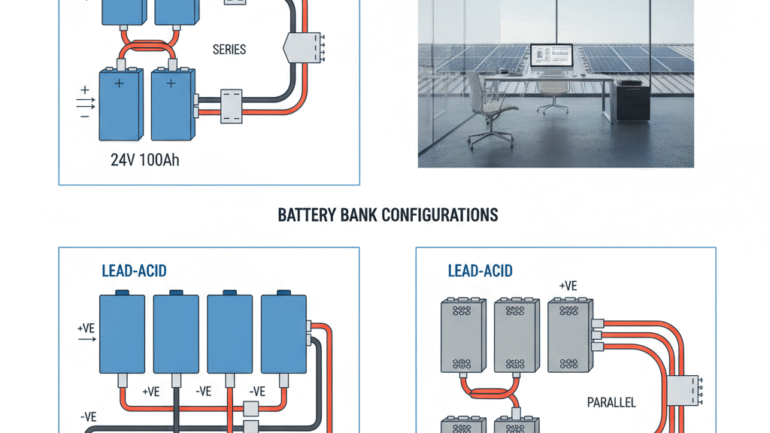
Wire batteries in series to increase voltage or parallel to increase capacity. Series connections add voltages while maintaining the same amp-hour capacity. Parallel connections maintain voltage while adding amp-hour capacities together.
Always use identical batteries in your bank for optimal performance. Mixing different ages, types, or capacities can cause premature failure and reduced system efficiency.
Safety and Installation Considerations
Proper ventilation prevents dangerous gas buildup, especially with lead-acid batteries. Install batteries in well-ventilated areas away from ignition sources. Lithium batteries produce no gases but still require temperature management for optimal performance.
Include proper fusing and disconnect switches for safety. Install fuses or breakers at the battery bank positive terminal to protect against short circuits. Use appropriately sized components based on your maximum current ratings.
Monitor battery voltage and state of charge regularly. Install a battery monitor to track performance and prevent over-discharge conditions. This extends battery life and ensures reliable power availability.
For comprehensive safety guidelines, review Solar Safety for DIYers for essential safety protocols and installation practices.
Optimizing Your Battery Bank Investment
Start with essential loads and expand gradually. Begin with a smaller battery bank covering critical needs, then add capacity as requirements grow. This phased approach spreads costs over time and allows learning from experience.
Furthermore, consider energy efficiency improvements before expanding battery capacity. Upgrading to LED lighting and efficient appliances reduces energy needs more cost-effectively than adding batteries.
Monitor actual usage patterns after installation to validate your calculations. Real-world consumption often differs from estimates, providing valuable data for future system adjustments or expansions.
Finally, factor in local climate conditions and seasonal variations. Cold temperatures reduce battery capacity while hot weather can shorten lifespan. Size accordingly for your specific environmental conditions and usage patterns.