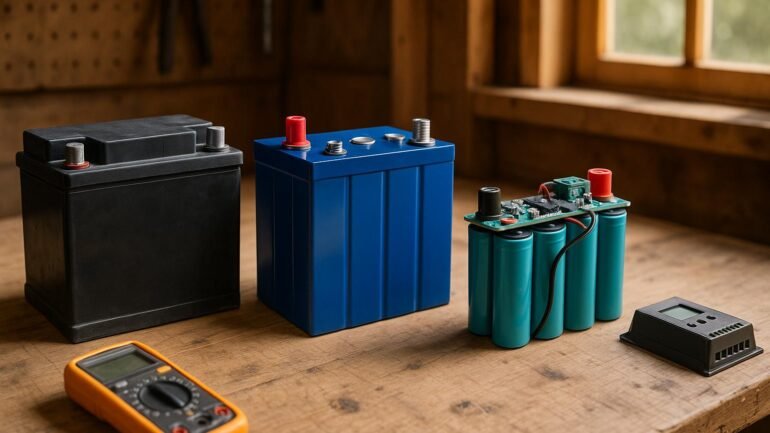
Understanding battery chemistry for starter backups
Choosing storage for a small solar setup is about balance. This guide explains the main chemistries used in home and RV systems and what matters for a starter backup: safety, longevity, cost, and maintenance.
Lead-acid basics
Lead-acid batteries are the traditional choice and come in flooded, AGM, and gel types. They’re inexpensive up front and widely available, but they’re heavy and take up space. Flooded models require regular electrolyte checks and ventilation, while AGM and gel variants are maintenance-light but still slower to cycle compared with modern lithium options.
- Low upfront cost per watt-hour
- Heavy and space-hungry
- Ventilation and maintenance for flooded types
- Cycle life varies with depth of discharge
LiFePO4 basics
LiFePO4, or lifepo4, is known for safety, lighter weight, and long life. It tolerates more charge/discharge cycles and requires little maintenance. These packs don’t vent hydrogen like flooded lead-acid, which makes them friendlier for small enclosures, though they cost more upfront.
- Longer cycle life and better safety
- Lightweight with better depth of discharge
- Low maintenance
- Higher upfront cost
Lithium-ion basics
Lithium-ion chemistries (like NMC and NCA) offer high energy density and compact packs. They’re great when space is tight, but they require a Battery Management System (BMS) and careful charging. They carry higher upfront costs and sensitivity to extreme temperatures, so a robust setup is important.
- High energy density
- Requires BMS and proper charging
- Temperature sensitive
- Moderate to long lifespan depending on chemistry
Safety, cost, and maintenance at a glance
Here are practical notes to compare the three options in real-world terms.
- Ventilation and safety: lead-acid flooded types need venting; lifepo4 and lithium-ion are safer in sealed enclosures.
- Maintenance: lead-acid needs watering and equalization; lifepo4 and lithium-ion require little to no routine maintenance.
- Cost per usable watt-hour: lead-acid is cheapest upfront; lifepo4 and lithium-ion cost more upfront but last longer and require less maintenance.
Which chemistry is right for you?
Your choice depends on space, budget, and how much you value long life vs. upfront cost.
- Budget and space: Choose lead-acid if you need to keep costs low and don’t mind heavier packs.
- Low maintenance and long life: LiFePO4 is a strong all-around choice for RVs and small home systems.
- Maximize space with high energy density and accept BMS requirements: lithium-ion can be ideal if you’re set up for a robust system.
Regardless of chemistry, pair your storage with a proper solar charger and a conservative charging strategy to maximize lifespan and reliability.